Welcome to WordPress. This is your first post. Edit or delete it, then start writing!
Blog
-
Why They Laid Down
The letter from Jenkins of the 105th Illinois possibly explains whey the rear three regiments of Ward’s 1st Brigade laid down while partway up the hill during the assault. Jenkins can be read to say that they planned to start laying one regiment down after firing so that the next can fire over their heads. Then he says they did not start firing until close to the battery. Toward the end of the same paragraph: “The way we charged & layed* down we got all mixed up.”
-
How Contents Were Chosen
What was selected to be included in the book? Anything that would shed light on the events, activities, and experiences of the soldiers. This includes what happened in the battle and how it happened, as well as plans of commanders. These are difficult to choose when trying to be historically accurate and completely dependent on testimony of others. Hence the quote from Lincoln’s instructions to the jury in the Rock Island Bridge Case regarding differing recollections: “We must take them at their word, as long as we can.”
‘As long as we can’ is the trick. Lincoln himself exploited it, planting questions when none had been raised, for example, and then not pursuing the answers, to leave doubt in the jurers’ minds. For this book, statements from multiple sources that were in agreement were prime. Statements that were clearly self-serving and contradicting what others had said which seemed reliable were omitted. Exceptions were included when the source was a primary authority, such as General John Geary, and the statements were more or less taken to be official though clearly wrong — they serve to demonstrate the contradictions and self-service and the reliability of not only Geary, for example, for others in his command. One example was official reports of the regiments in one of his brigades for the 15th of May: they were clearly dictated by one person. Such statements, when the contradictory, are included, as in this book, serve to reveal errors in other books.
So, if they could not be taken at their word, this book shows why, especially with the differing testimony.
However, generally, figuring out what commanders intended or did from scanty or ambiguous quotes was avoided. Partly because it is likely to be wrong in some way and partly because there was plenty to learn anyway.
One tough example is why, how, and when Colonel Ireland’s, 1st Brigade of Geary’s division got mixed up with Coburn’s 2nd Brigade in Butterfield’s division when Butterfields assault got underway. Accounts are too vague. But some that agree with other accounts and are clearer were included.
Before Butterfield deployed, Geary and Robinson had their divisions formed up by the Dalton road just north of the hills that were to be fought over. It is clear Ireland’s brigade was with his division, which was behind Robinson’s. When Butterfield brought his division up (they seem to have waited for ammunition while he conferred with Geary and Robinson and Hooker), he went ahead of the other divisions and gave his their orders and they started to deploy. Butterfield then got information that the left hill was infested and he gave orders for Wood’s brigade to clear them out before the assault began. Wood had been expected to follow Ward’s brigade en echelon on the left and Coburn was to follow on the right. Here is where things went haywire and stories got quite as mixed up as the regiments, even absurdly so.
There not enough room in the ravine they were to have started from. Wood was left on the road and Coburn was at the bottom of the ravine, not even able to get the regiments in the needed arrangement till after Ward got out of the way. Yet, by all accounts, Ireland’s brigade was right of Coburn by the time Coburn started forward and then crashed right though them, going left. How did he get there. And why?
One scenario imagines an aid galloping up to Geary with a note to send a brigade to replace Wood on Ward’s left. (Geary had no more idea of terrain and conditions as the others — even less the Butterfield’s men would have by then.) That would explain the “unmilitary way” Alexander described Geary as putting the division in motion.
One of Ireland’s men wrote that when they left the formation and entered the ravine they passed by Wood’s right regiment. That has not been contradicted, though it is only one source.
Question arises: Did Ireland actually start into the ravine before Coburn? Seems a plausible explanation, but only speculation. Yet he did get on Coburn’s right. Coburn did not expect Ireland to crash into him. Did he even know he was there? Ireland apparently was just as surprised. Their is no agreement by men of either brigade on about which was the other brigade.
A historian should be looking for multiple sources and finding those that are at least somewhat verifiable instead of trying to figure out a narrative to explain events or reasons without much to go on.
Side note regarding reliability: Captain Alexander, of 111th PA in Ireland’s brigade describes the day but in such a way that it seems almost entirely second hand, even the part included in the book. Perhaps more, instead of less, should have been included so that readers can find out for themselves what is reliable. One that stands out is the claim that the 111th drove the gunners out of the fort. That contradicts everyone else, who say Butterfield’s men, mostly Ward and Coburn’s men, did the fighting. Other of Geary’s own men who state they did not enter the fort but instead laid down in front of it after they got there. (Note, Geary’s division was sent up to replace Butterfield’s after the fight was over and helped hold the fort — from the outside).
So, many sources help find out what stories are more reliable and which are suspect and to perhaps resolve some questions. If they completely contradicted and did not reveal anything new, they were omitted. But if ambiguity resulted, that needed to be for the reader to discern. If they gave reader some real perspective, even insight, into how much is not gospel, they might have been included.
Note: Geary’s claims have been taken for granted in all history written about the battle — until this one. Others say Wood was behind Ward, as planned. And none mention the fight over who captured the guns — they take Geary at his official record and claims by some of his men, who fought in print for the glory.
-

As Seen in the Painting
Benjamin Harrison to his wife Carrie:
It is wonderful how much skill and labor Johnston has expended on defensive works from Dalton to this place. He has these defensive line prepared in advance, or rather in his rear, and when we flank him out from his line he has only to fall back to another a few miles to the rear, then we are forced to make such movements as will force him to retreat again, and so the campaign has dragged along.
Those who blame Sherman for what they call inactivity ought to serve under him for a few days & make a survey of, or an assault on, one of Johnston’s defensive lines & they would take a new view of it.
As you have never seen one of these field works, I must try to give you an idea of what an assaulting column has to overcome. In the first place in advancing you will come at 1000 yards from the enemy’s works into a “tangle,” that is, all the small trees and some & some larger ones are felled crosswise so that you have to make your way through a continual succession of tree tops. As you get nearer say 300 yards, you come to an “abatis” which consists of tree-tops laid with the bushy ends towards you, all the leaves trimmed off and every branch twig sharpened so that it will catch in the clothes. If you succeed getting through this, you will find about 20 yards from the rifle pits two lines of stakes about 12 feet long, set about four feet in the ground and inclining towards you, the upper end being sharpened and stakes set so close that a man can’t pass between them. If you can stand the deadly stream of musketry fire until you can dig up or down these stakes, you will have no other obstacle save the climb of the breastworks and a line of bayonets jetting up inside. In some places they also have what the boys call “horse rakes”, but technically called “Cheval de frise”. These are made by boring large auger holes through logs 20 feet long or so, at right angles, and putting through them long oaken stakes or pines sharpened at both end so that however many times you may turn the thing over, there is ways an ugly line of sharpened stakes sticking out towards you.
I would like to see a few thousand of the “On to Atlanta” civilians of the North charging such a line of works. Most of the tender skinned individuals of this class would require help to get into the works if they were empty.
Benjamin Harrison, July 10, 1864, near Atlanta, Georgia
-
Edmund Randolph Brown

27th INDIANA. Promoted from Private. Wounded at Antietam–left of navel. Declined promotion to Sergeant over those absent wounded; Detached service as clerk for post Provost Marshall office Tullahoma Tennessee 11-1-1863 to 8-1864. Mustered out 10-1-1864. Regimental Historian – wrote The Twenty-Seventh Indiana Volunteer Infantry in the War of the Rebellion, (1899). From Winamac, Pulaski County, Indiana, USA. Died March 14, 1930. Birth unknown.
(Missing from book’s profiles of contributors.)
-
Corput’s Battle Flag
After midnight, the Rebels were long gone and the Fifth Ohio Infantry, who were digging the guns (and claimed to be the only ones doing it), had already sent two down the hill, when:
“It was about this time that Corporal George W. Tyrrell, of Company H, Fifth Ohio, handed me the rebel flag that he had taken from the flag-staff of the redoubt. It was the usual bunting red flag, with the blue St. Andrew’s cross, with stars. I handed it in with my official report. Corporal Tyrrell afterward received a medal of honor for the capture of the flag referred to.”
This is as reported by Colonel Kilpatrick, in Sketches of War History, Volume IV, page 246-254 The Fifth Ohio Infantry at Resaca. The flag was forwarded to Washington by General Geary: from “Record of Rebel Flags Captured by Union Troops After April 19, 1861”, National Archives, RG 94.
This image is from a website that no longer can be contacted. The National Archive reports that all Confederate Flags were returned to their states under a resolution of Congress in 1905.

-
Steve Noon Painting
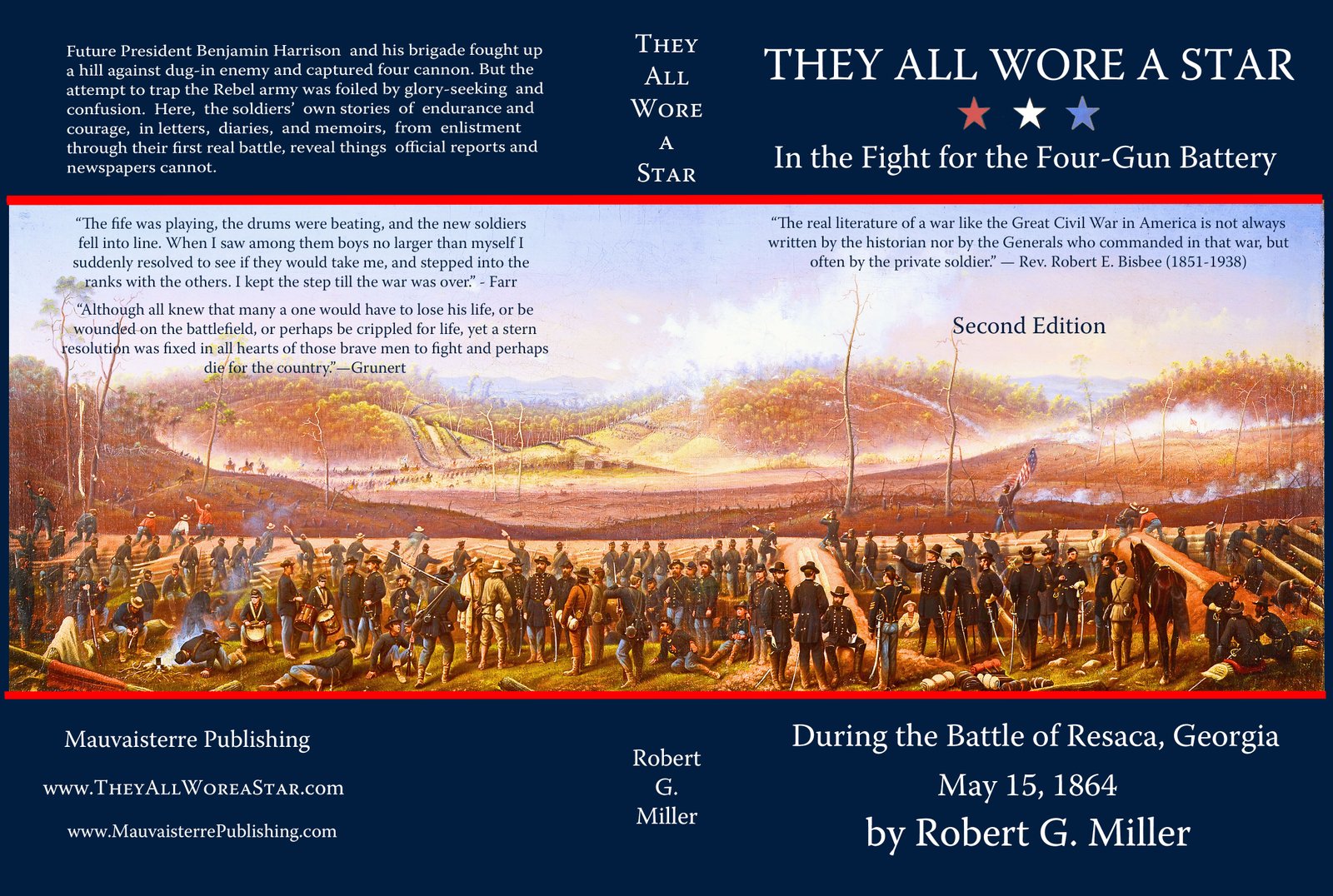
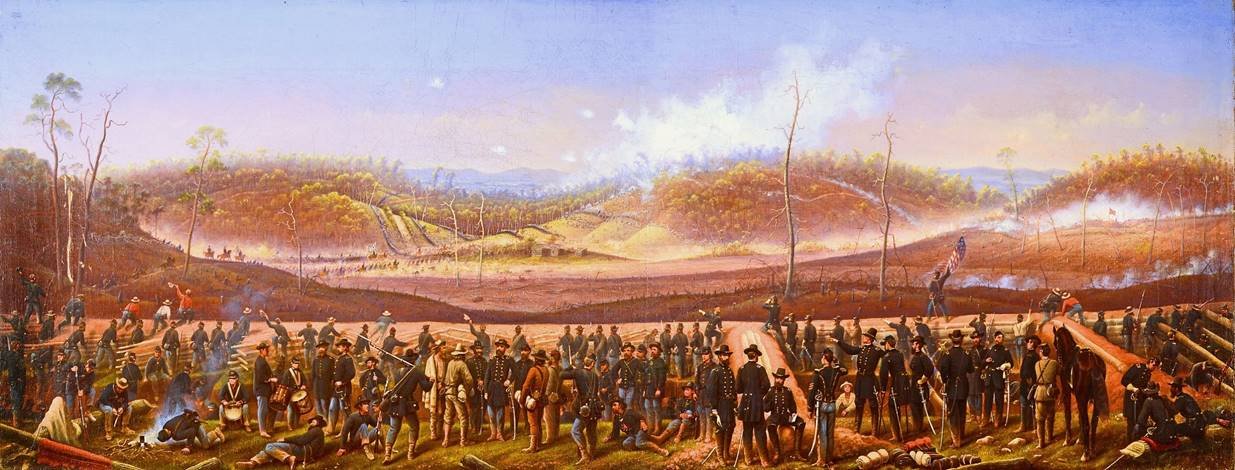
English artist Steve Noon painted this for the cover of Atlanta 1864 by James Donnell. John Fritz, whose ancestor fought at the fort, bought the original and asked to have a copy posted here. Later I will put it in a page of its own. Steven Noon corrected the flags and added a Spencer rifle after some Resaca folks offered more information about them. More difficult to correct, and left alone, was Benjamin Harrison’s horse. Mr. Noon had seen the lithograph and web sites showing Harrison on horseback, though not in a scene of the fort. The setting is quite realistic–the fort looks just like that. And the soldiers are set about as one would expect from the stories.

Resaca, May 15, 1864 ,by Steve Noon -
Artillery Work
Simonson’s battery pushed their guns to the limit. If fired too fast, the hot guns swelled, making loading difficult or impossible, as well as dangerous. Sometimes they put wet blankets over the barrel. The man who put his thumb over the touch hole, to quell embers, wore a leather glove at least. Their equipment also included a pole with a corkscrew hook–using that would take some plain old guts, such as when Wes Conner was driven from his cannon and left it double loaded after two primers had failed. Robert Hale Strong describes watching them work.
“Our artillerymen were stripped to the waist for their work. It was a sight to watch them firing those cannons. Each man at the cannon is numbered, and each number has just certain things to do. He does this with the regularity of clock work, and does nothing else. The caisson holding the ammunition is brought up to a few feet in rear of the cannon, the horses are unhitched and taken a short distance to the rear and hidden if possible, and firing begins. One man brings the powder cartridge from the caisson. Another man shoves it into the cannon muzzle. Another one rams it down. By this time, the first man has returned from the caisson with a shot or a shell. If it is a shell and the fuse is already cut to the required length, the shell is passed on to the cannon, inserted and rammed home. If not properly fused, the fuse is adjusted first. Then the priming is inserted in the touch hole and the string that fires the cannon is pulled. After the shell screams out and the cannon recoils, the cannon is run back into position. Then one man puts his finger over the touch hole to keep out air. Another with a swab or sponge on a pole wipes out the cannon. Another shell is inserted and fired. As this is done two or three times in a minute, everybody is on the jump. Every so often, the end of the swab is dipped in a bucket of water and the cannon thoroughly washed out.1 If an artilleryman is killed or wounded, another stands ready to take his place. Each is trained to do the next man’s job when needed. At this time we had a good view of the enemy’s guns and of their lines behind. We could see our shells burst inside their lines. One shell knocked a wheel off one of their cannon. All this time, their shells were striking and bursting among us. Some of our gunner men were just literally blown to pieces. As they were, the next one would take his place. It was a grand sight, but a horrible one.”
Strong, Robert Hale. A Yankee Private’s Civil War (Dover Military History, Weapons, Armor) . Dover Publications. Kindle Edition.
-
Grab a Root!
Officers, in their elevated positions on horseback, had to duck shells, by reflex, to the amusement of those whose feet were on the ground instead of in stirrups. The catch-phrase of desperation no doubt arose from climbing steep slopes and perhaps being swept downstream as well.
From History of the 90th Ohio: “Grab a Root”:
While soldiering in the Army of the Cumberland,
Some Johnnies to shoot.
We stubbed our toe, fell down in the mud,
And the boys, hollowed, ”Grab a Root !”
The origin of the word we never heard.
Yet, it always seemed to suit,
For, no matter what to you occurred,
They would tell you to “Grab a Root.”
The Colonel of the 31st rode a mare —
A scary sort of a brute —
At the Catoosa Springs she threw him.
When one of the boys hollowed, “Grab a Root.”
A new recruit was stealing meat.
Because he thought it cute,
But when the guard marched him off to Gen. Cruft,
The boys hollowed, “Grab a Root.”
At Ooltewah we were crossing on a log
With a canteen full of old jute.
When we lost our balance and in we went.
And Smith hollowed, “Grab a Root.”
A drunken bummer rode a mouse-colored mule —
A bucking son-of-a-galoot —
And when he threw him and nearly broke his neck.
The boys hollowed, “Grab a Root.”
A goose hissed at us when we foraged,
As a disloyal old brute.
But when the Major ordered us front in disgrace,
George Harney whispered, “Grab a Root.”
Down in Hog- Jaw Valley we heard a gun,
For some one in the distance did shoot.
But at the command, “Attention ! I heard a gun,”
Some one remarked, “Grab a Root.”
We shot the load from our gun in camp,
When there was positive orders not to shoot ;
But as the General was placing us on the General’s
staff,
The boys hollowed, “Grab a Root.”
A dude of a Sergeant got full of beer ;
He sang a song he thought was cute,
But at the end of every verse he sang,
The boys hollowed, “Grab a Root.”
The Sergeant got mad and wanted to fight.
And finally began talking shoot.
Then he stormed and raved till he foamed at the mouth.
And the boys hollowed, “Grab a Root.”
An officer swore it was cowardly to dodge
When the Johnnies too near would shoot,
But when he dropped at a shell passing high in the air,
The boys hollowed, “Grab a Root.”
Sylvester Rader, Co. T. -
Omissions
Though the book shows much soldiers’ attitudes and experiences, some things were deliberately left out.
One was some negative attitudes toward negroes. While not the rule by any means, some soldiers were convinced they’d never accept them. The range varied the spectrum, but most were accepting and often disgusted and incensed by the treatment slaves received. Uncle Ned seemed to be a more typical example, gaining respect in Joe Peters’s company and going with them from Tennessee till the war was over and they went home.
Except for the comment of General Williams, those comparing Cumberland area whites poorly to negroes were omitted, though they were common. One was enough.